Mastering ChatGPT: The Ultimate Prompt Toolkit Guide
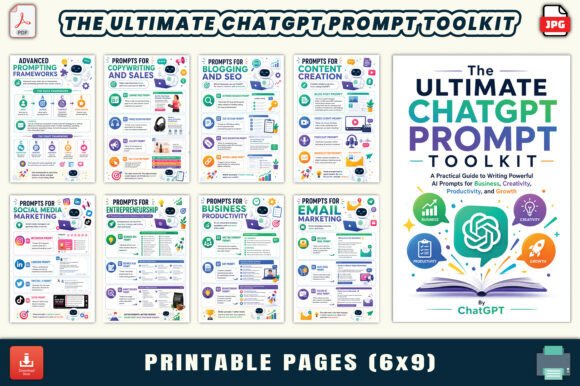
If you are tired of getting generic, uninspired answers from ChatGPT, the issue likely isn't the AI—it's the input. Just as a designer needs the right premium font to create a compelling brand identity, you need the right prompts to unlock high-quality AI output. The Ultimate ChatGPT Prompt Toolkit is less about magic tricks and more about engineering precision. This 30-page resource is built for the practical creator: the entrepreneur juggling content calendars, the marketer drafting email sequences, and the student trying to streamline research. It strips away the hype and focuses on the anatomy of a request that actually gets results.
Visual Clarity and Structural Appeal
One of the first things you notice about this toolkit is that it doesn't look like a standard, dry technical manual. It borrows heavily from modern editorial design principles, utilizing a clean layout that makes dense information digestible. The structure mimics high-end design assets—it is organized with clear visual hierarchy, ensuring that you aren't overwhelmed by walls of text.
From a design perspective, the personality of the toolkit is professional yet approachable. It avoids the chaotic look of many "hacker" guides, instead opting for a style that feels at home on the desk of a creative director or a startup founder. The choice of typography within the guide itself aids readability; it uses a balanced mix of weights to distinguish headers from body text, proving that functional modern typography is just as important in a PDF as it is on a website. Whether you are viewing the print-ready PDF or the digital files, the layout remains consistent, offering a visual experience that is easy on the eyes during long study sessions.
Applying Prompt Engineering Across Industries
The true value of the Ultimate ChatGPT Prompt Toolkit lies in its versatility. It functions much like a versatile serif font or a clean sans serif font—it fits almost anywhere. For content creators and bloggers, the section on SEO & Blogging Prompts is invaluable. It moves beyond simple keyword stuffing and teaches you how to instruct the AI to generate outlines that capture search intent while maintaining a natural, conversational flow. This is crucial for anyone trying to build authority without sounding robotic.
For those in branding and marketing, the toolkit offers a framework for generating copy that sells. Think of it as the font pairing strategy for your marketing funnel. You learn how to combine different prompt "weights"—context, persona, and format—to generate copywriting & sales prompts that actually convert. Whether you are writing social media graphics captions or long-form email sequences, the methods taught here help maintain brand consistency. It ensures that the tone of voice generated by the AI matches the personality of your brand identity, whether that requires the elegance of a script font or the boldness of a display font.
Enhancing Productivity and Workflow
Beyond marketing, the toolkit serves as a critical asset for business automation. Small business owners often wear too many hats; this guide helps you offload mental load to the AI effectively. It covers productivity frameworks that allow you to use ChatGPT for data analysis, summarizing meeting notes, or even drafting project proposals. The "Ready-to-use examples" included in the 30 pages act as templates, similar to how a designer might use a grid system to speed up web design or packaging design.
The guide also addresses the needs of freelancers and job seekers. The modules on resume & career prompts are particularly practical. Instead of asking the AI to "write a resume," you are taught to provide specific parameters that result in a document that highlights achievements over duties. This attention to detail mirrors the difference between using a free, generic typeface and investing in a commercial font—the latter simply performs better in professional settings.
Practical Guidance for Implementation
To get the most out of this resource, treat it like a design tool rather than a book. Just as you would test a handwritten font or creative font in different contexts before finalizing a design, you should test the prompts in various scenarios. Don't just copy and paste; adapt the frameworks to your specific niche. The toolkit provides the skeleton, but your industry knowledge provides the muscle.
Evaluate the prompts based on the output quality. If the AI produces vague results, refer back to the "Anatomy of a Perfect Prompt" section. Often, the fix is adding more context—a technique known as "grounding." This is similar to adjusting kerning in typography; small tweaks to the input can drastically improve the readability and impact of the final result. The toolkit is designed to be a living document in your workflow, something you reference whenever you hit a creative block or need to scale your content production without sacrificing quality.
Ultimately, the Ultimate ChatGPT Prompt Toolkit is about taking control of the technology. It empowers you to move from being a passive user of AI to an active engineer of your own content and business processes. By applying these structured prompts, you save time, reduce frustration, and produce work that resonates with your audience.